
Designing a concrete driveway means knowing that its thickness is one of the most important choices to make if you need a durable and long-lasting driveway. Whether you’re installing a new driveway or refurbishing an old one, how many years would you like your driveway to last and still remain attractive enough to withstand vehicle weight, avoid cracking, and not wear out after a few decades?
In this guide from Concrete in Buffalo, we will break down everything homeowners need to know about the thickness of a concrete driveway, starting with the general recommendation for the ideal driveway thickness, as well as the factors that determine the correct thickness. Let’s roll in and examine the effects of pavers, resurfacing, and proper installation on the life of your driveway.
Understanding the Purpose of Driveway Thickness of Concrete
The concrete driveways are designed to withstand high traffic, shifting weather conditions, and the natural movement of the ground. The thickness of your driveway would be the determining factor in whether it can sustain these stresses without fracturing or sinking.
Whenever the slab is very thin, it will start to experience cracks and become worn out when vehicles weigh on it or during the freezing and thawing of the ground. Conversely, an oversized driveway may be more expensive than it should be. The aim is to strike a balance that is both efficient and sustainable, yet cost-effective and material-wise.
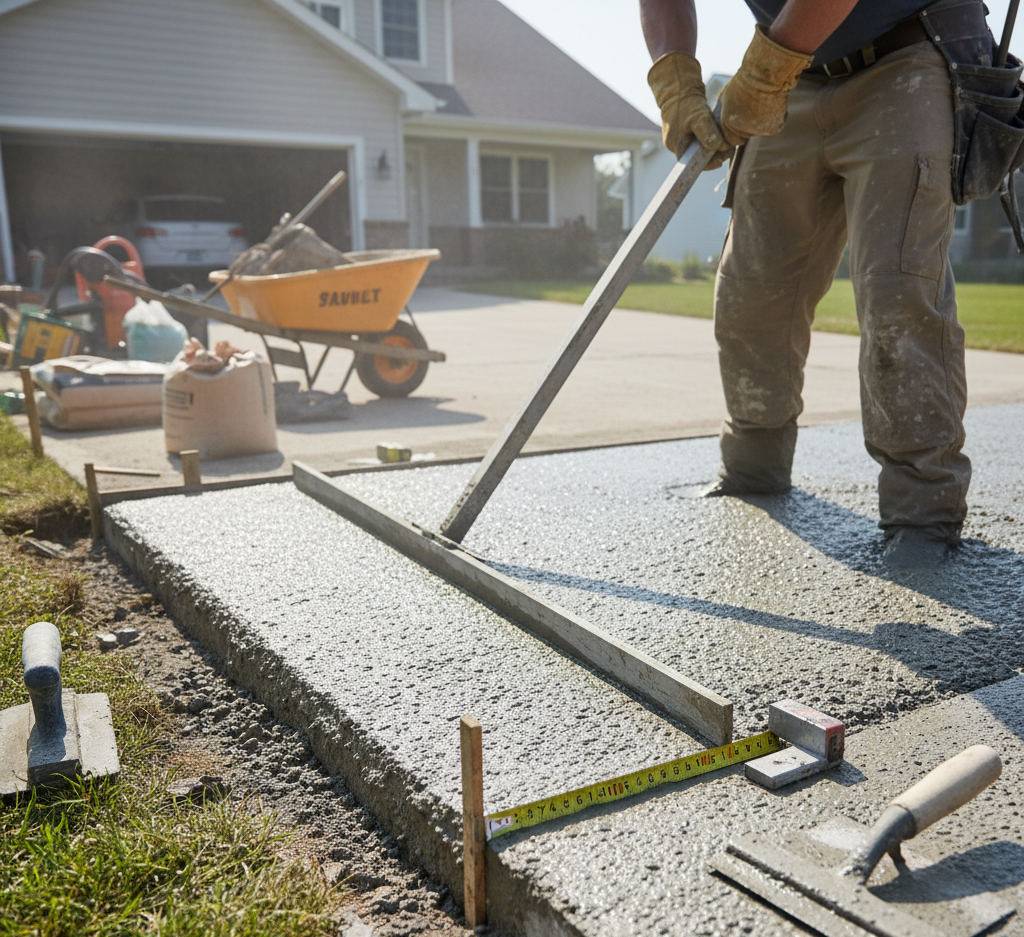
Contractor-Recommended Thickness for Concrete Driveways
The recommended standard thicknesses by professional concrete driveway installers are usually as follows,
1. Residential Driveways – 4 Inches Thick
A concrete driveway that is 4 inches in thickness is the standard in most cases. It provides a strong base of cars and light trucks, as well as normal home usage. It is very strong and durable when poured and cured properly.
- Contractors tend to use a 4-inch driveway,
- Additional structural integrity by means of rebar or wire mesh.
- Correct base preparation, e.g., a 4- 6 inch layer of compacted gravel.
2. Heavy-Duty Driveways – 5 to 6 Inches Thick
If your driveway is frequently used by heavier vehicles, such as outdoor vehicles (RVs, trailers, or construction equipment), contractors suggest a 5- to 6-inch concrete pad.
With a thicker slab, the load is evenly spread and the chances of cracking are minimized. In such applications, various types of concrete mixes can be optimized to achieve greater strength.
3. Decorative Driveways with Pavers – 1 to 4 Inches Thick Pavers
Some people opt for paver designs instead of pouring concrete. In this instance, the thickness of the paver is important; 1-inch-thick pavers are typically laid out as a patio or walkway, rather than a driveway.
A 4-inch-thick paver is designed to manage vehicle traffic and is as strong as poured concrete when installed on compacted ground.
Factors That Affect Ideal Driveway Thickness
Several factors can affect the thickness of your driveway. We may consider the most significant of them,
1. Soil Type and Ground Stability
A driveway may move or sink due to soft or expansive soil. Under such circumstances, contractors tend to add 1-2 inches to the concrete thickness of the driveway or deepen the gravel base.
2. Expected Load
A regular single-family house with car usage does not require as much strength as a home that houses a delivery truck or RVs. Always ensure that the concrete pad is as thick as the weightiest vehicle.
3. Climate Conditions
In regions with a freeze-thaw cycle, such as the Northeast and Midwest, concrete is more likely to crack. To avoid such damage on the surface, contractors typically recommend using slabs that are slightly heavier or concrete that is stronger in nature.
4. Reinforcement and Base Preparation
The ideal thickness of slabs will not support the weight without a well-prepared base. A concrete driveway with a stable gravel base and steel support is a life-saving investment in the stability of your driveway.
What is Concrete Driveway Resurfacing: When to Repair Instead of Replace
Concrete driveway resurfacing can be used to restore your driveway’s appearance and functionality without replacing the entire driveway, which would be quite costly, even if the driveway is structurally sound.
Resurfacing is the process of laying a thin layer of concrete on the existing surface. It is suitable for small surface cracks, and it is much cheaper than filling another concrete driveway.
Resurfacing can also be used to correct any unevenness or refresh the appearance by incorporating decorative finishes or new designs for the pavings.
Fixing an Existing Concrete Driveway
When your driveway is sinking, cracking, or showing signs of wear, it is essential to determine whether you want to resurface or replace it altogether.
Here’s how to fix a concrete driveway depending on the issue:
- Minor Cracks – Fill them using either epoxy or a crack filler to prevent water penetration.
- Surface Damage – Resurfacing a concrete driveway is preferable to update the surface.
- Cracks in Structure or Sinking – You may require a fresh pour with a better base, or the slab might need to be thicker.
In certain situations, an option would be asphalt resurfacing, which is cheaper when compared to concrete but has poorer durability and appearance.
Let’s do a Comparison Between Concrete Driveways and Paver Driveways
The concrete driveway and paver designs both have tremendous curb appeal, although they differ in terms of price, maintenance, and performance.
| Feature | Concrete Driveway | Paver Driveway |
| Paver Driveway | 4–6 inches | 1–4 inches (pavers) |
| Durability | With reinforcement- very high | With proper installation, very high |
| Maintenance | Need sealing occasionally | Individual pavers can be more easily installed |
| Cost | Upfront cost is low | Upfront cost is high, and it is easier to repair |
| Aesthetic Variety | Limited to finishes | Wide range of patterns and colors |
Concrete is a smooth and low-maintenance finish. However, when it comes to customization, 4-inch thick pavers are strong and allow design capability.
The Role of Different Types of Concrete and Mix Design
Not every concrete is the same. Contractors use various types of concrete depending on the project. The compressive strength of the mix (in PSI) is what defines the ability of the mix to withstand pressure.
- 3,000 PSI– Driveway residential standards.
- 4,000-5,000 PSI – Its application is suitable for heavy loads or in cold weather.
- High-Performance Mixes– Additives containing additives to help add resistance to freezing and lower absorption of water.
Your concrete driveway builders will select the appropriate mix based on your area, traffic volumes, and the type of soil.
Why Professional Installation Matters
Regardless of the thickness of the driveway (concrete), its life may be reduced due to improper installation. Well-trained installers of concrete driveways guarantee,
- An accurately done base compaction.
- Precision slope for drainage.
- Correct placement of reinforcement.
- Accurate slab curing times.
A professional contractor, such as Concrete in Buffalo, also assists in determining what you want to do with your full replacement, resurfacing of a concrete driveway, or even asphalt resurfacing, based on your budget and the condition of the area.
From Angi: Wondering how much a concrete driveway costs in 2025?
Key Takeaways
- The thickness of the majority of residential concrete driveways is 4 inches.
- Heavy vehicles or unstable soil should be in the range between 5 and 6 inches.
- Paver is ornamental only, 1-inch thick, not driveway worthy.
- Properly laid pavers will be 4-inch thick and able to match the strength of concrete.
- Base, reinforcement, and curing are all considered as important as the slab thickness.
Surfacing should be considered when you notice surface damage on your driveway, even if it is structurally sound.
Wanna go eco-friendly? Then you must read this blog: Eco Friendly Concrete Buffalo, NY | Sustainable Solutions.
Final Thoughts
The thickness of the concrete driveway that you select determines whether your investment will be made over decades. Whether in pavers that are 4-inch thick or reinforced slabs, all the details count as regards strength, safety, and curb appeal.
In case you are installing a new concrete driveway or you are repairing a concrete driveway, check with concrete driveway installers such as Concrete in Buffalo. They are able to assess your soil, traffic load, and local climate just to suggest the best solution, be it new construction, concrete driveway resurfacing, or asphalt resurfacing.
A good concrete driveway is not merely a car park; it is an investment in your home’s worth and its beauty over a very long period of time.
Contact Concrete in Buffalo
Schedule a service with our experts in Concrete in Buffalo for guidance on the correct concrete driveway thickness and precision installations!
Visit: Concrete Buffalo, NY
Call: (716)3966033
FAQs
1. How thick is the average concrete driveway?
The majority of contractors suggest the use of a 4-inch concrete driveway at home. In the case of heavy vehicles, 5 to 6 inches is a good choice.
2. Is it possible to use 1-inch-thick pavers in my driveway?
Pavers of 1 inch in thickness are unsuitable for vehicle traffic. Strength and durability- Select pavers with 4-inch thickness.
3. What do I do to repair a crack in my concrete?
Small cracks might be sealed with sealant, and bigger ruptures could demand concrete driveway resurfacing or even replacement.
4. Should resurfacing be used in place of replacing a driveway made of concrete?
Resurfacing is cheaper and more environmentally friendly than installing a new one if your current one is still structurally sound.